
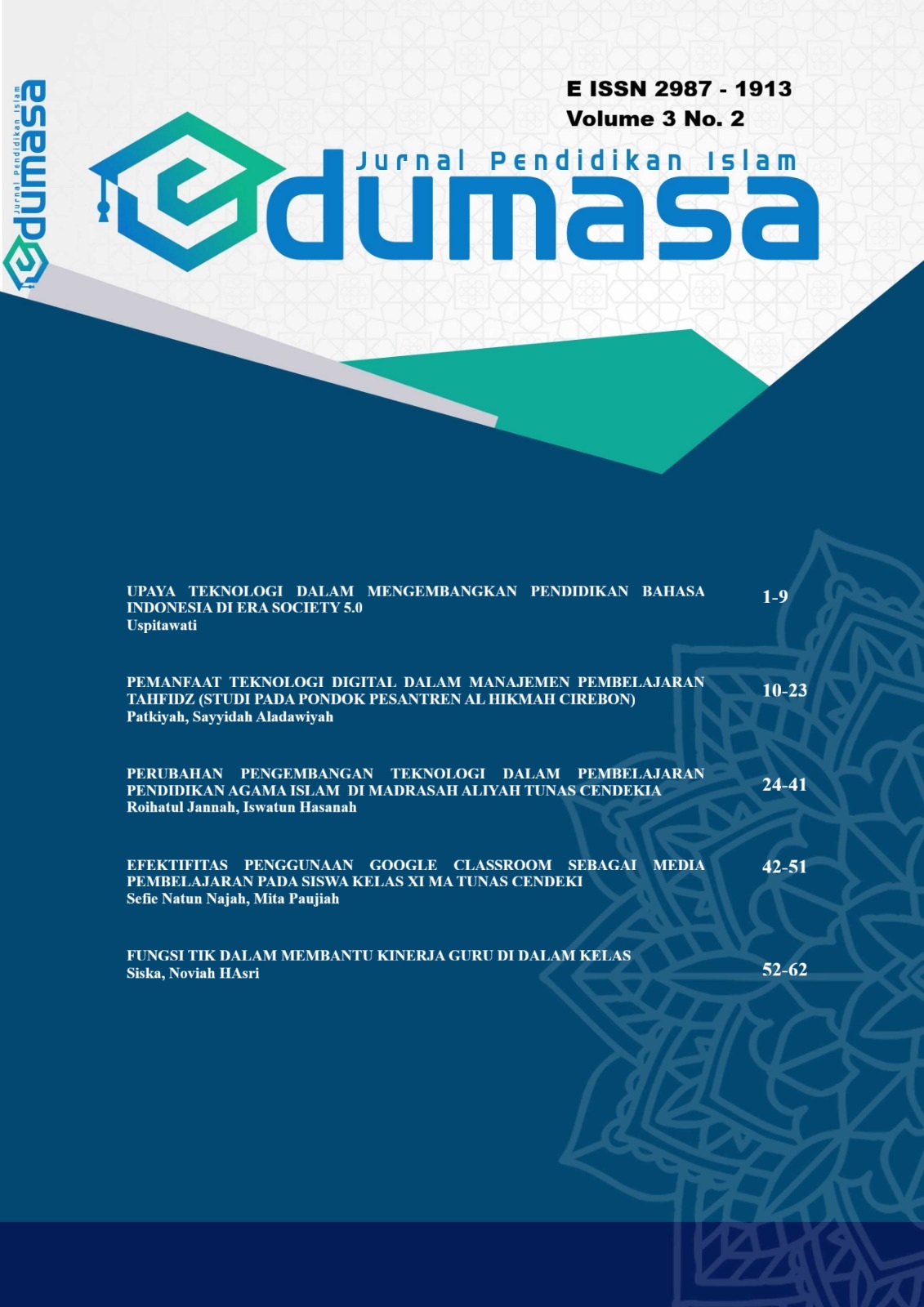
FUNGSI TIK DALAM MEMBANTU KINERJA GURU DI DALAM KELAS
Article Sidebar
Main Article Content
Abstract
Information and Communication Technology (ICT) has become an integral part of modern education, particularly in enhancing teachers’ performance in the classroom. The utilization of ICT not only supports teachers in delivering learning materials but also contributes to various aspects of professionalism and teaching effectiveness. This study aims to analyze the functions and contributions of ICT in supporting teacher performance and its impact on the quality of the teaching and learning process. The research employed a descriptive qualitative approach through a literature study technique that refers to various scientific sources related to the use of ICT in education. The results indicate that ICT plays a significant role in supporting teachers’ tasks, including: (1) facilitating the delivery of learning materials in a more interactive, engaging manner and aligned with students’ learning styles; (2) improving efficiency in administrative tasks, data management, and classroom organization through digital platforms; (3) expanding access to more diverse and up-to-date learning resources; (4) simplifying the implementation of learning evaluation and assessment through technology-based systems; and (5) fostering more effective collaboration and communication between teachers, students, and fellow educators. The optimal use of ICT can enhance the quality of teacher performance in designing, implementing, and evaluating instruction. This improvement positively contributes to increasing students’ motivation, participation, and learning outcomes, thereby supporting the achievement of educational goals in the current digital era.
Article Details

This work is licensed under a Creative Commons Attribution-ShareAlike 4.0 International License.
References
Andriani, T. (2015). Sistem Pembelajaran Berbasis Teknologi Informasi dan Komunikasi. Sosial Budaya, 12(1), 127–150.
Creswell, J. W. (2014). Research Design: Qualitative, Quantitative, and Mixed Methods Approaches. SAGE Publications.
Ghavifekr, S., & Rosdy, W. A. W. (2015). Teaching and Learning with Technology: Effectiveness of ICT Integration in Schools. International Journal of Research in Education and Science, 1(2), 175–191.
Habibi, M. W. (2020). Pemanfaatan Teknologi Informasi dan Komunikasi dalam Pembelajaran di Era Digital. Jurnal Pendidikan Islam, 11(1), 55–70.
Hidayat, Y., Yudiyanto, M., Mukhlisin, Malik Sofy, A. R., Nurishlah, L., Hadi, D. S., Mulyani, A. S., Wahidah, E., Firdaus, M. R., Dini, A., & others. (2024). STUDENT CENTER: memahami peserta didik dari berbagai aspek. CV. Intake Pustaka.
Kemdikbudristek. (2022). Panduan Implementasi Kurikulum Merdeka. Kementerian Pendidikan, Kebudayaan, Riset, dan Teknologi.
Mukhlisin, M., Sofy, M., Hadi, D. S., & Uspitawati, U. (2023). Nilai-Nilai Keislaman pada Pendidikan Ketarunaan (Studi terhadap SMK Pelayaran Buana Bahari Cirebon). Al-Fikri: Jurnal Studi Dan Penelitian Pendidikan Islam, 6(1), 33–52.
Munir. (2008). Teknologi Pendidikan: Konsep dan Aplikasinya. Kencana.
Munir. (2017). Pembelajaran Digital. Alfabeta.
Nugroho, A., & Prasetyo, D. (2023a). Cloud computing dalam pengelolaan sistem akademik. Jurnal Sistem Informasi, 19(1), 101–110.
Nugroho, A., & Prasetyo, D. (2023b). Cloud Computing dalam Pengelolaan Sistem Akademik. Jurnal Sistem Informasi, 19(1), 101–110.
Nugroho, A., & Surjono, H. D. (2019). Pengembangan Kompetensi Guru dalam Mengintegrasikan Teknologi Informasi dan Komunikasi pada Pembelajaran. Jurnal Inovasi Teknologi Pendidikan, 6(2), 168–179.
Permana, R. H., & Nouvalian, A. (2019). Pengaruh Pemanfaatan Teknologi Informasi dan Komunikasi terhadap Kinerja Guru SMA. Jurnal Pendidikan Manajemen Perkantoran, 4(2), 223–232.
Prasojo, L. D. (2013). Sistem Informasi Manajemen. UNY Press.
Prasojo, L. D., Habibi, A., Mukminin, A., Sofyan, S., Indrayana, B., & Anwar, K. (2018). Building Quality Education through Integrating ICT in Schools: Teachers’ Attitudes, Perception, and Barriers. Quality Assurance in Education, 26(2), 165–176.
Prawiradilaga, D. S. (2016). Mozaik Teknologi Pendidikan: E-Learning. Kencana.
Rusman. (2018). Belajar dan Pembelajaran Berbasis Komputer: Mengembangkan Profesionalisme Guru Abad 21. Alfabeta.
Simanihuruk, L., Simarmata, J., Sudirman, A., Hasibuan, M. S., Safitri, M., Sulaiman, O. K., Ramadhani, R., & Sahir, S. H. (2019). E-Learning: Implementasi, Strategi dan Inovasinya. Yayasan Kita Menulis.
Suartama, I. K., & Tastra, I. D. K. (2014). E-Learning Berbasis Moodle. Graha Ilmu.
Sugiono. (2010). Metode Penelitian Pendidikan. Alfabeta.
UNESCO. (2015). Global education monitoring report. UNESCO.
Wulandari, F., & Suryadi, E. (2019). Pemanfaatan Teknologi Informasi dan Komunikasi dalam Meningkatkan Kualitas Pembelajaran. Jurnal Teknologi Pendidikan, 8(1), 45–58.
Yusuf, M., & Wekke, I. S. (2015). Active Learning on Teaching Arabic for Special Purpose in Indonesian Pesantren. Procedia - Social and Behavioral Sciences, 191, 137–141.