
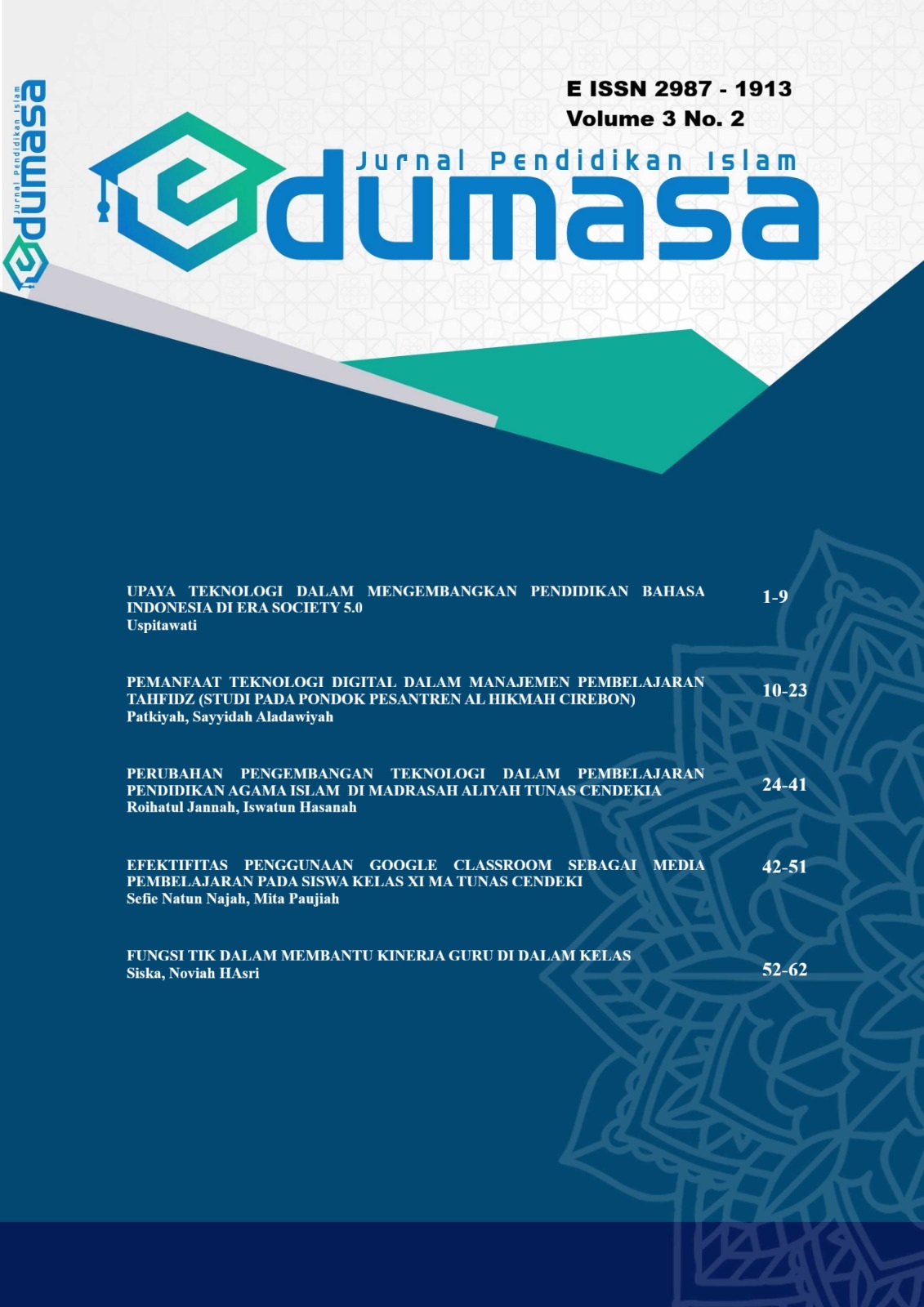
PERUBAHAN PENGEMBANGAN TEKNOLOGI DALAM PEMBELAJARAN PENDIDIKAN AGAMA ISLAM DI MADRASAH ALIYAH TUNAS CENDEKIA
Article Sidebar
Main Article Content
Abstract
This research examines the integration and development of educational technology in Islamic Religious Education learning at Madrasah Aliyah Tunas Scholar. In the contemporary digital era, technology plays a crucial role in enhancing students' learning experiences and deepening their understanding of religious sciences. This qualitative study employs an interview-based methodology, engaging with educators, administrators, and students to comprehensively assess the technological landscape of PAI instruction. The findings reveal that Madrasah Aliyah Tunas Scholar has successfully implemented various internet-based learning platforms and applications, including Microsoft PowerPoint for content delivery, Quizizz for interactive assessments, Google Classroom for learning management, and other complementary digital tools. These technologies facilitate student-centered learning environments that prioritize active engagement and collaborative learning spaces. The research demonstrates that technology integration significantly contributes to innovative pedagogical approaches, fostering critical thinking skills and transforming students' cognitive development in understanding Islamic teachings. The outcome-based learning framework adopted by the institution emphasizes measurable learning achievements while promoting collaborative knowledge construction among students. This study concludes that strategic technology implementation in PAI learning not only modernizes traditional teaching methods but also creates dynamic, interactive educational experiences that prepare students for 21st-century challenges while maintaining the authenticity of Islamic values and teachings.
Article Details

This work is licensed under a Creative Commons Attribution-ShareAlike 4.0 International License.
References
Al-Attas, S. M. N. (1979). Aims and objectives of Islamic education. Hodder and Stoughton.
Arthur, J. (2003). Education with character: The moral economy of schooling. Routledge.
Branch, R. M. (2009). Instructional design: The ADDIE approach. Springer.
Calvani, A., Cartelli, A., Fini, A., & Ranieri, M. (2012). Models and instruments for assessing digital competence at school. Journal of E-Learning and Knowledge Society, 8(3), 183–193.
Carr, A., & Stefaniak, J. (2012). Technology-enhanced learning and instructional design. In R. A. Reiser & J. V Dempsey (Eds.), Trends and issues in instructional design and technology (3rd ed., pp. 232–240). Pearson.
Churiyah, M., & Sakdiyyah, D. A. (2020). Indonesia education readiness conducting distance learning in Covid-19 pandemic situation. International Journal of Multicultural and Multireligious Understanding, 7(6), 491–507.
Creswell, J. W. (2013). Research Design. Pustaka Pelajar.
Darling-Hammond, L., Hyler, M. E., & Gardner, M. (2017). Effective teacher professional development.
Dick, W., Carey, L., & Carey, J. O. (2015). The systematic design of instruction (8th ed.). Pearson.
Ertmer, P. A., & Ottenbreit-Leftwich, A. T. (2010). Teacher technology change: How knowledge, confidence, beliefs, and culture intersect. Journal of Research on Technology in Education, 42(3), 255–284.
Fauzah, O., Purbaya, D., & Mukhlisin. (2025). The Implementation Of A Planting Project Method To Foster Independence In Children Aged 5--6 Years. IJIEL: Indonesian Journal of Islamic Education and Learning, 1(1), 22–28.
Framework, P. (2019). Framework for 21st century learning definitions.
Fullan, M. (2013). Stratosphere: Integrating technology, pedagogy, and change knowledge. Pearson.
Gilster, P. (1997). Digital literacy. Wiley.
Glazer, E. M., Hannafin, M. J., & Song, L. (2009). Promoting technology integration through collaborative apprenticeship. Educational Technology Research and Development, 57(1), 57–77.
Graham, C. R. (2006). Blended learning systems: Definition, current trends, and future directions. In C. J. Bonk & C. R. Graham (Eds.), The handbook of blended learning: Global perspectives, local designs (pp. 3–21). Pfeiffer.
Hague, C., & Payton, S. (2010). Digital literacy across the curriculum.
Hodges, C., Moore, S., Lockee, B., Trust, T., & Bond, A. (2020). The difference between emergency remote teaching and online learning. Educause Review, 27, 1–12.
Jones, L. M., & Mitchell, K. J. (2016). Defining and measuring youth digital citizenship. New Media & Society, 18(9), 2063–2079.
Kemendikbud, P. (2020). Statistik kompetensi TIK guru Indonesia.
Kemendikbudristek. (2022). Panduan Pembelajaran PAUD dalam Kurikulum Merdeka. Direktorat Jenderal PAUD, Dikdas, dan Dikmen.
Kirkpatrick, D. L., & Kirkpatrick, J. D. (2006). Evaluating Training Programs: The Four Levels (3rd ed.). Berrett-Koehler Publishers.
Kasus Pengaduan Anak. https://bankdata.kpai.go.id/tabulasi-data/data-kasus-pengaduan-anak-2016-2020
Lickona, T. (2013). Pendidikan karakter: Panduan lengkap untuk mendidik siswa menjadi pintar dan baik. Bumi Aksara.
Livingstone, S., & Haddon, L. (2009). Kids online: Opportunities and risks for children. Policy Press.
Martin, J. A., Reaume, K. M., Reeves, E. M., & Wright, R. D. (2012). Relationship building with students and instructors of ESL. Reference Services Review, 40(3), 352–367. https://doi.org/10.1108/00907321211254634
Mukhlisin, Indah, R. Y., & Atsa, A. (2023). The Implementation Of Prophet’s Character Education At Al-Multazam II. Jurnal Pendidikan Islam: Dumasa, 1(1), 13–23. https://doi.org/10.15294/edumasa.v9i2
Mukhlisin, M., & Sofy, M. (2025). Pendampingan dan Peningkatan Perilaku Keagamaan Remaja Pasca Pendidikan Dasar melalui Kultur Pesantren di Desa Sindangbarang. KOMUNITA: Jurnal Pengabdian Dan Pemberdayaan Masyarakat, 4(2), 173–184.
Mukhlisin, M., Sofy, M., Hadi, D. S., & Uspitawati, U. (2023). Nilai-Nilai Keislaman pada Pendidikan Ketarunaan (Studi terhadap SMK Pelayaran Buana Bahari Cirebon). Al-Fikri: Jurnal Studi Dan Penelitian Pendidikan Islam, 6(1), 33–52.
Mukhlisin, M., Sofy, M., Purbaya, D., & Rifai, A. (2024). Implementation of Social Educational Values in the Pillars of Islam at Pondok Pesantren Miftahussa’adah Sindangbarang. TA’DIB: Jurnal Pendidikan Agama Islam, 2(2), 139–153.
Mukhlisin, M., Yuniawati, R. I., & Atsa’lawi, A. (2023). The Implementation of Prophet’s Character Education at Al-Multazam II. EduMasa: Journal of Islamic Education, 1(1), 13–23.
Mukhlisin Mukhlisin; Malik Sofy; (2025). Kultur pesantren. Intake Pustaka. https://scholar.google.co.id/citations?view_op=view_citation&hl=id&user=G5P_PZYAAAAJ&citation_for_view=G5P_PZYAAAAJ:3fE2CSJIrl8C
Mukhlisin Mukhlisin; Malik Sofy; Deden Purbaya, A. R. (2024). Implementasi Nilai Pendidikan Sosial dalam Rukun Islam di Pondok Pesantren Miftahussa ’ adah Sindangbarang. 31–42.
Ni’amah, K., & M, H. S. (2021). Teori Pembelajaran Kognivistik dan Aplikasinya dalam Pendidikan Islam. Jurnal Ilmiah Mahasiswa Raushan Fikr, 10(2), 204–217. https://doi.org/10.24090/jimrf.v10i2.4947
Nicholas, D., Rowlands, I., Clark, D., & Williams, P. (2011). Google generation II: Web behaviour experiments with the BBC. Aslib Proceedings, 63(1), 28–45.
Prensky, M. (2001). Digital natives, digital immigrants. On the Horizon, 9(5), 1–6.
Rahmawati, M., & Mukminan, M. (2021). Pengembangan model pembelajaran berbasis teknologi informasi dan komunikasi untuk meningkatkan literasi digital siswa. Jurnal Inovasi Teknologi Pendidikan, 8(1), 1–15.
Ribble, M. (2015). Digital citizenship in schools: Nine elements all students should know (3rd ed.). International Society for Technology in Education.
Seels, B. B., & Richey, R. C. (1994). Instructional technology: The definition and domains of the field. Association for Educational Communications and Technology.
Sutrisno, M. (2018). Agama dan Kearifan Lokal di Nusantara. Pustaka Rizki Putra.
Voogt, J., & Roblin, N. P. (2012). A comparative analysis of international frameworks for 21st century competences: Implications for national curriculum policies. Journal of Curriculum Studies, 44(3), 299–321.